SGCI News
Namibia’s young innovators are developing practical solutions to some of the country’s pressing challenges, from improving mobility for people with visual impairments to finding ways of storing solar energy for…
Namibia’s young innovators are developing practical solutions to some of the country’s pressing challenges, from improving mobility for people with visual impairments to finding ways of storing solar energy for use when sunlight is unavailable.
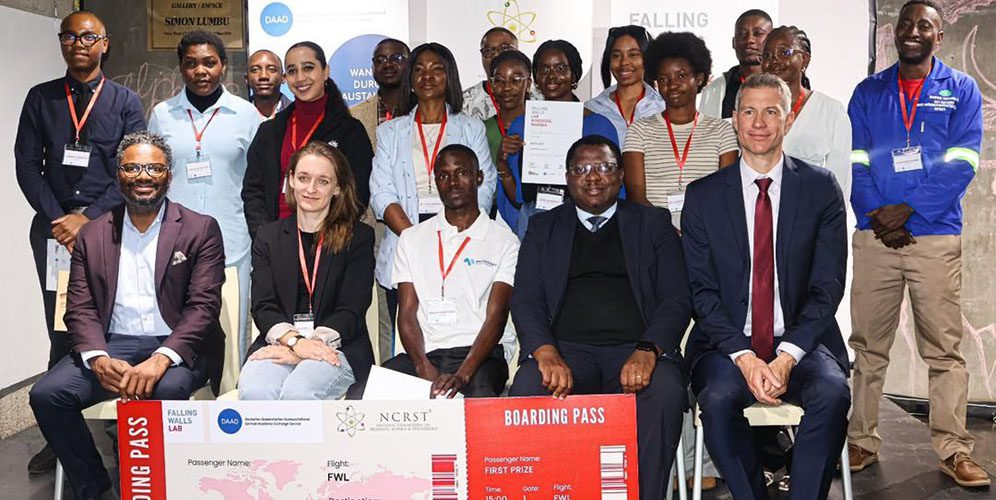
These ideas were showcased at the Falling Walls Lab Namibia 2026, hosted by the National Commission on Research, Science and Technology (NCRST), in partnership with the German Academic Exchange Service (DAAD), in Windhoek.
The competition gave young Namibians three minutes to pitch breakthrough ideas, while providing an opportunity to receive feedback from experts, gain exposure and connect with potential collaborators.
Speaking on behalf of NCRST ceo, Anicia Peters, Simon Nghipangwa, general manager for business support services, emphasised the importance of creating platforms where young innovators can present their ideas and engage with experts and potential collaborators.
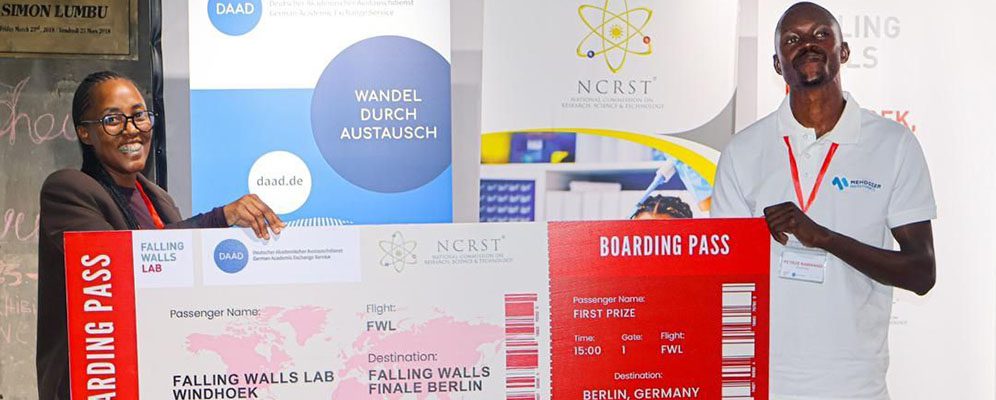
The competition was won by Petrus Namwandi for his proposed Blind Mobility solution, which seeks to transform the traditional white cane into a smart mobility device for visually impaired people.
Namwandi’s proposed device uses ultrasonic sensors to detect obstacles before physical contact and alerts the user through vibrations. It also incorporates an emergency button and location-sharing functionality, allowing users to request assistance and share their location with a designated caregiver.
His win will take the innovation beyond Namibia. Namwandi will represent the country at the Falling Walls Global Finale in Berlin, where he will present Blind Mobility to an international audience. He will also receive pitch training from NCRST ahead of the event.
The Global Finale is scheduled for 6 November, with Namwandi travelling to Berlin from 5 to 11 November. The programme will also include the Falling Walls Science Summit, running from 6 to 9 November, bringing together researchers, scientists, entrepreneurs and other leaders in science and innovation.
Secilia Naule was named second runner-up for her proposed solar thermal energy storage solution, which stores solar energy as heat for use when sunlight is unavailable. She received an Innovation Development Voucher valued at N$5,000.
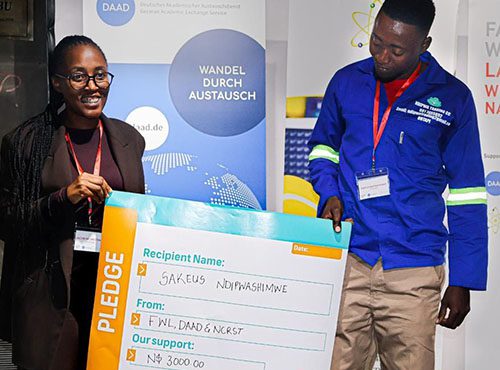
Sakeus Ndipwashimwe took third runner-up and received an Innovation Development Voucher valued at N$3,000.
Namwandi and Naule also jointly received the Audience Award after tying in the audience vote.
The competition highlights the potential of platforms that connect emerging innovators with technical expertise, exposure and opportunities to develop their ideas further.
For NCRST, supporting platforms such as Falling Walls Lab forms part of its wider role in strengthening Namibia’s research, science, technology and innovation ecosystem and creating opportunities for young people to turn innovative ideas into solutions.
The opportunities for collaboration extend beyond national platforms. Through the STISA-2034 multilateral research call, African researchers and institutions are being encouraged to work across borders to develop solutions in areas critical to the continent’s development, including health, agriculture, artificial intelligence and digital technologies, energy and the environment.
Full eligibility requirements, participating countries, and consortium-building resources are available on the call’s official landing page. Applicants are encouraged to review these details closely before beginning a proposal, and to use the matchmaking platform to confirm potential partners meet the call’s country and institutional criteria.
The call is supported through a partnership of African Science Granting Councils, the International Development Research Centre (IDRC), the Government of Norway, the UK’s Foreign, Commonwealth & Development Office (FCDO), and Wellcome.
Explore the full eligibility requirements and access the application portal at https://call.sgci.africa/. Expressions of interest are due September 25, 2026.
Please check out the stories and let us know what you think. We would love to hear from you!
Let’s continue the conversation on our social media.
Published on 3 September 2026
By Jackie Opara-Fatoye
Related News
NRF champions science, climate action and youth empowerment
Kenya’s National Research Fund (NRF) is strengthening efforts to connect scientific research, innovation and youth participation with practical responses to climate and environmental challenges. NRF chief executive officer Dickson Andala represented the fund at the launch of the Climate Policy and Advocacy Training – Cohort…
Windhoek Declaration: African science funders pledge to act as one
Science granting councils say Africa’s research systems need African ownership, steadier funding and less fragmentation. Here is what they agreed in Windhoek. African science granting councils adopted a collective declaration in Windhoek, Namibia, on 1 October 2026, as part of the Science Granting Councils Initiative…
Africa’s science councils urged to turn pledges into real impact
[NAMIBIA] African countries must strengthen collaboration, invest in research and scientists, and take greater ownership of science, technology and innovation if research is to deliver lasting development impact, participants at the 2026 Science Granting Councils Initiative (SGCI) All Partners Forum have said. The call came…
Research and Resources

SGCI funded projects
Rwanda’s integrated approach to sustainable agriculture and nutrition
Project Titles & Institution Areas of Research Number of Projects being funded Project Duration Grant Amount In-Kind Distribution Council Collaboration with other councils