SGCI News
For generations, communities around Malawi’s lakes have depended on wild fish catches for both food and income. But shrinking fish stocks, rising demand, and population growth are putting increasing pressure…
For generations, communities around Malawi’s lakes have depended on wild fish catches for both food and income. But shrinking fish stocks, rising demand, and population growth are putting increasing pressure on capture fisheries, threatening a vital source of nutrition for many households.
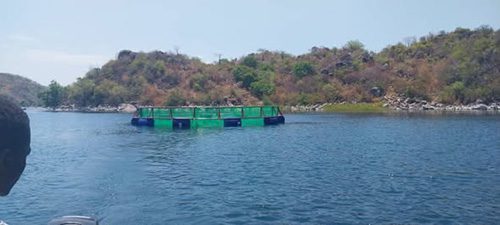
Now, a project supported by the National Commission for Science and Technology, Malawi, with funding from the Science Granting Councils Initiative, is helping communities in Likoma turn to a more sustainable solution – the small-scale cage aquaculture.
Implemented by Mzuzu University in collaboration with the Likoma District Fisheries Office, the project seeks to promote fish farming by constructing and installing floating cages in the lake, stocked with healthy, improved fingerlings.
The initiative comes at a critical time for Malawi’s fisheries sector. According to a study by WorldFish, the declining availability of wild-caught fish and a growing population have created an urgent need for greater investment in aquaculture value chains.
The study notes that per capita fish consumption in Malawi has declined in recent years due to heightened demand and reduced supply, even as fish remains one of the country’s most important sources of protein and micronutrients.
Fanuel Kapute, a professor of fisheries science and aquaculture at Mzuzu University and one of the lead researchers on the project, says the initiative is designed not only to increase fish production but also to build resilience within local communities.
“By integrating modern aquaculture technology with strong community participation, the project reduces reliance on the declining capture fisheries while ensuring responsible resource use and environmental stewardship,” Kapute explained.
“This model strengthens livelihoods, secures a consistent fish supply, and promotes shared ownership through effective knowledge transfer. It demonstrates how innovation and collaboration can build resilience in Malawi’s food systems.”
The SGCI grant, amounting to K32,500,000, supported implementation of the project over a two-year period from January 2024 to December 2025.
During that period, farmers stocked the cages four times, with the final harvest taking place on 8 February 2026. From the last stocking cycle alone, farmers harvested 2,760 kilograms of fish, with each fish weighing an average of 350 grams.
The fish sold at K14,000 per kilogram, generating total sales of K38,000,000. The researchers say that the results demonstrate the strong economic potential of community-led cage aquaculture.
The approach also echoes growing scientific consensus on the role aquaculture can play in strengthening food security. The report by WorldFish shows that Malawi’s smallholder aquaculture sector still has vast untapped potential despite more than a century of fish farming history.
The study highlights that improving access to quality fingerlings, better fish feed, and modern production systems could significantly increase fish availability while helping vulnerable communities cope with food insecurity.
In Malawi, where fish contribute significantly to diets and livelihoods, experts say expanding aquaculture is increasingly important as capture fisheries struggle to keep pace with demand.
For communities in Likoma, the benefits are already becoming visible.
Kapute says that beyond profitability, the initiative contributes to long-term sustainability by protecting wild fish stocks, encouraging environmentally friendly practices, and empowering local communities with practical aquaculture skills.
“Its success provides a scalable blueprint for expanding cage aquaculture across Malawi’s lakeshore districts, enhancing national food security, creating employment opportunities, and laying the foundation for a resilient aquaculture industry that will benefit generations to come,” he said.
Please check out the stories and let us know what you think. We would love to hear from you!
Let’s continue the conversation on our social media
Published on 18 May 2026
By Jackie Opara-Fatoye
Related News
Voices from the SGCI Forum: Building an African-led science system
From calls for African-led research funding to stronger engagement with communities and governments, participants at the 2026 Science Granting Councils Initiative (SGCI) All Partners Forum left Windhoek with a shared sense that Africa’s science and innovation systems are entering a new phase. Held from 28…
NRF champions science, climate action and youth empowerment
Kenya’s National Research Fund (NRF) is strengthening efforts to connect scientific research, innovation and youth participation with practical responses to climate and environmental challenges. NRF chief executive officer Dickson Andala represented the fund at the launch of the Climate Policy and Advocacy Training – Cohort…
Windhoek Declaration: African science funders pledge to act as one
Science granting councils say Africa’s research systems need African ownership, steadier funding and less fragmentation. Here is what they agreed in Windhoek. African science granting councils adopted a collective declaration in Windhoek, Namibia, on 1 October 2026, as part of the Science Granting Councils Initiative…


SGCI funded projects
Rwanda’s integrated approach to sustainable agriculture and nutrition
Project Titles & Institution Areas of Research Number of Projects being funded Project Duration Grant Amount In-Kind Distribution Council Collaboration with other councils