SGCI News
[NAMIBIA] African science granting councils are examining their reliance on international research funding as a new dashboard reveals the flow of science, technology and innovation (STI) funding into Africa. More…
[NAMIBIA] African science granting councils are examining their reliance on international research funding as a new dashboard reveals the flow of science, technology and innovation (STI) funding into Africa.
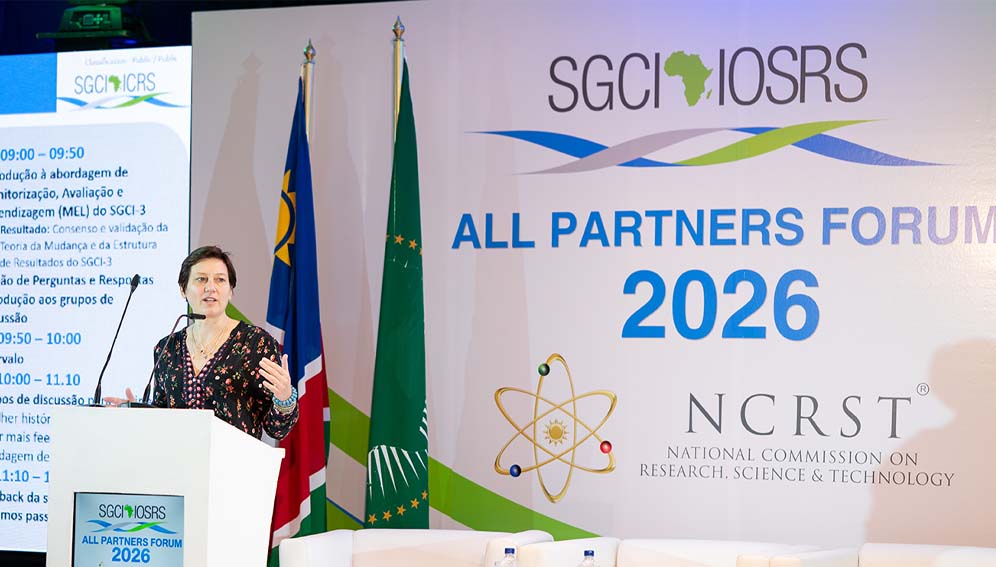
More than 170 delegates from across the world are attending the 2026 Science Granting Councils Initiative (SGCI) All Partners Forum, which opened in Windhoek, Namibia, on Monday 28 September.
The first day of the forum, hosted by Namibia’s National Commission on Research, Science and Technology (NCRST), focused on partnerships between science granting councils, funders and other organisations supporting research and innovation across Africa.
A key session featured Johann Mouton, director of the DSI-NRF Centre of Excellence for Scientometrics and STI Policy and professor at the Centre for Research on Evaluation, Science and Technology (CREST), Stellenbosch University, South Africa, demonstrating the latest version of the STI Funding for and in Africa Dashboard.
The dashboard tracks STI research funding flows into Africa and lets users examine funding patterns, compare countries, and identify potential collaborators.
Mouton said CREST and Stellenbosch University had spent the past three years collecting data from more than 250 international funders.
“What we have been doing over the past two years as CREST and Stellenbosch is to build the first ever database and dashboard that tracks the flow of STI research funding to Africa,” he said.
The dashboard, he added, could support strategic planning, resource allocation, priority setting, comparative benchmarking and the identification of potential collaborators for funding applications.
Mouton said Kenya and South Africa were among the most funded recipients in the data.
For some science granting councils, the data prompted questions about the sustainability of their research funding systems.
Atridah Mulonga, acting manager for programme development and implementation at Zambia’s National Science and Technology Council, said the dashboard offered councils an opportunity to examine their dependence on external funding.
“This helps us to see whether we are really doing enough as councils,” she said.
“The data shows that we are getting a lot of funding from outside; however, what we provide is very little compared to what we receive. That raises questions about sustainability. What if one day they stop funding us?”
Mulonga said the dashboard could also help councils determine where additional funding was needed, identify fields receiving more support than others and reduce duplication.
“It helps us with planning because it indicates what has been funded and who the funders were,” she said.
Building partnerships
The forum’s first day was designated Partnership Day, with partner-led sessions supported by the SGCI Funders Collaborative bringing together funders, innovation agencies, science granting councils and other partner organisations.
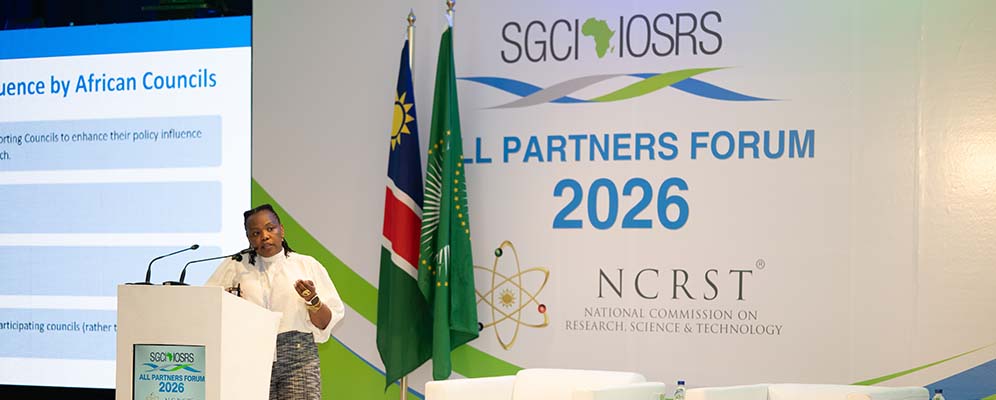
Marcus Wilms, director for international collaboration with Africa and the Middle East at the German Research Foundation (DFG), said the funders’ collaborative meetings were among the highlights of the first day.
He said the partners viewed their role as a long-term collaboration with science granting councils rather than simply providing funding.
“We do not consider ourselves as donors or funders but as collaborators in the long-standing partnership to support the councils’ capacity and partnership building,” Wilms said.
For newer science funding institutions, participation in the SGCI network is providing an opportunity to learn from more established councils.
Rejoice Maseko of Eswatini said the experience was particularly important as the country establishes its National Research Council following the approval of legislation in 2023.
“This means a lot for Eswatini as we are just establishing the National Research Council,” she said.
Through the SGCI network, Maseko said she had gained a better understanding of what was required to operationalise a research funding council.
“We realise that we can co-fund a project between two or more councils,” she said. “We have learnt that there are so many partners outside the region that are funding research, while we knew only a few.”
The forum is being held under the theme “From Commitment to Action”, with discussions focused on strengthening partnerships and mechanisms for delivering more effective research and innovation systems across Africa.
Established in 2015, the SGCI has supported science granting councils in Sub-Saharan Africa to strengthen research funding, policy and collaboration.
The 2026 All Partners Forum runs from 28 September to 2 October in Windhoek.
Please check out the stories and let us know what you think. We would love to hear from you!
Let’s continue the conversation on our social media
Published on 29 September 2026
By Charlotte Nambadja, reporting from the SGCI All Partners Forum in Windhoek, Namibia
Related News
NRF champions science, climate action and youth empowerment
Kenya’s National Research Fund (NRF) is strengthening efforts to connect scientific research, innovation and youth participation with practical responses to climate and environmental challenges. NRF chief executive officer Dickson Andala represented the fund at the launch of the Climate Policy and Advocacy Training – Cohort…
Windhoek Declaration: African science funders pledge to act as one
Science granting councils say Africa’s research systems need African ownership, steadier funding and less fragmentation. Here is what they agreed in Windhoek. African science granting councils adopted a collective declaration in Windhoek, Namibia, on 1 October 2026, as part of the Science Granting Councils Initiative…
Africa’s science councils urged to turn pledges into real impact
[NAMIBIA] African countries must strengthen collaboration, invest in research and scientists, and take greater ownership of science, technology and innovation if research is to deliver lasting development impact, participants at the 2026 Science Granting Councils Initiative (SGCI) All Partners Forum have said. The call came…


SGCI funded projects

Rwanda’s integrated approach to sustainable agriculture and nutrition
Project Titles & Institution Areas of Research Number of Projects being funded Project Duration Grant Amount In-Kind Distribution Council Collaboration with other councils