
SGCI News
In many parts of the world, people worry about dirty water they can see, muddy streams, industrial waste, or plastic pollution. But scientists are increasingly concerned about the invisible traces…
In many parts of the world, people worry about dirty water they can see, muddy streams, industrial waste, or plastic pollution. But scientists are increasingly concerned about the invisible traces of medicines quietly flowing through rivers and drinking water systems with little means to stop them.
A researcher Selina Ama Saah, a materials chemist, from the Department of Chemical Sciences at the University of Energy and Natural Resources, Ghana, and her team are developing a low-cost material to trap pharmaceutical pollutants that conventional treatment systems cannot reach.
“Pharmaceuticals are designed to be biologically active,” she says.
“Even at very low concentrations, they can have unintended effects on aquatic organisms, on ecosystems, and potentially on human health over time.”
A hidden and growing threat
Pharmaceutical pollution of water bodies is increasingly being detected across Africa, yet it rarely makes headlines and is monitored only sporadically.
Hospitals, households, pharmaceutical manufacturers, and agricultural runoff all contribute residues that enter water bodies largely untreated.
The presence of antibiotics in water environments accelerates the development of drug-resistant bacteria, a problem the World Health Organization has called one of the greatest threats facing humanity.
In developing regions, limited wastewater infrastructure makes communities especially vulnerable.
“Wastewater treatment systems are often limited, which means pharmaceutical-laden water may reach communities with little to no treatment,” Saah says.
Building a smarter material
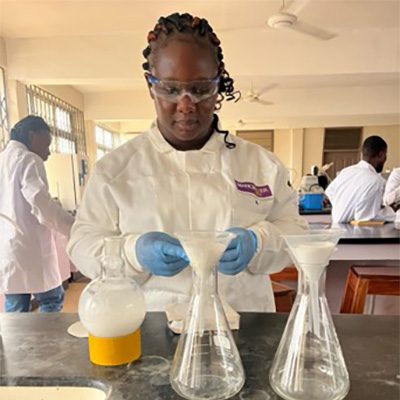
Saah’s project, titled ‘Sustainable Remediation of Pharmaceutical Residue Pollution in Water Bodies: Biochar Nanocomposite Adsorption Approach’, is developing a composite material designed specifically to trap and destroy pharmaceutical contaminants.
The researchers are combining biochar, a charcoal-like material produced from biomass waste, with zinc oxide nanoparticles.
Biochar acts like a sponge, attracting pollutants onto its porous surface, while the nanoparticles degrade them under light via a photocatalytic process, a dual-action system that tackles contaminants conventional treatment struggles to remove.
Saah’s team uses a solventless synthesis method, eliminating the need for toxic, expensive organic solvents. It is a greener process, cheaper, and better suited to scaling up in resource-limited settings. Early results are encouraging: the team has produced nanostructures with high purity and controlled shapes that increase surface area and improve pollutant removal efficiency.
A meaningful step forward
Independent energy and sustainability expert, the chief executive officer of Clean Technology Hub, Ifeoma Malo, believes the research directly addresses a neglected category of pollution that existing systems fail to remove.
“What distinguishes this research is the deliberate integration of two complementary materials into a single composite system tailored specifically for pharmaceutical residues,” she says. “In a field where many technologies are either too costly, too energy-intensive, or not specifically designed for pharmaceutical contaminants, this approach offers a meaningful advancement.”
Malo notes that while zinc oxide nanoparticles require careful handling and further safety study, fixing them onto stable matrices like biochar reduces the risk of free particles entering treated water. “We advocate for a precautionary but progressive approach that does not halt innovation, but ensures safety evaluations keep pace with scientific development,” she says.
From lab bench to community tap
Significant hurdles remain before the technology can move from laboratory to everyday use, among them scale-up consistency, nanoparticle recovery, regulatory approval, and community acceptance.
Malo says progress will require collaboration across chemistry, engineering, public health, and policymaking, as well as pilot testing in real water environments representative of conditions in Ghana and across the region.
Saah says that the materials could be incorporated into simple filtration units or coated membranes at the household or community level, drawing on agricultural waste for the biochar component and avoiding expensive inputs, reducing dependence on imported technology.
SGCI funding and next steps
The SGCI funding has been pivotal in getting the research to its current stage, supporting equipment, materials, characterisation tools, and the training of students and early-career researchers.
“It created an enabling environment for capacity building, ensuring that the expertise being developed does not remain with a single researcher but takes root in the next generation of Ghanaian scientists,” Saah says.
Next steps include developing and optimising full biochar–zinc oxide composites and moving toward pilot-scale testing.
Industry and stakeholder partnerships are being explored to facilitate eventual technology transfer.
Beyond the scientific breakthroughs, Saah hopes the research will contribute to a future where communities can access cleaner and safer water using technologies developed with local realities in mind.
“The ultimate goal is to improve access to clean water, reduce environmental pollution, and support public health,” she says.
Please check out the stories and let us know what you think. We would love to hear from you!
Let’s continue the conversation on our social media
Published on 26 May 2026
By Jackie Opara-Fatoye
Related News

Namibia project uses household data, smart meters to rethink water
In Namibia, having water nearby does not always mean having reliable water at home. In Rundu, a growing urban centre on the perennial Okavango River, households reported the highest level of water insecurity among three towns studied by researchers. The finding illustrates a wider challenge…
From commitment to action: why the 2026 All Partners Forum matters
When partners gather in Windhoek, Namibia, for the 2026 Science Granting Councils Initiative (SGCI) All Partners Forum, they will meet at an important point in the evolution of Africa’s science, technology and innovation landscape. The Forum will be held from 28 September to 1 October…

STISA-2034:Turning research into policy through knowledge uptake
Africa produces a growing body of research on the challenges shaping everyday life, yet a persistent gap remains between generating evidence and putting it to use. Research findings may be published in journals, presented at conferences and archived in institutional repositories, but too often they…
Research and Resources

SGCI funded projects

Rwanda’s integrated approach to sustainable agriculture and nutrition
Project Titles & Institution Areas of Research Number of Projects being funded Project Duration Grant Amount In-Kind Distribution Council Collaboration with other councils