
Story of Change
Researchers say waste material at a Botswana nickel mine contains viable amounts of nickel, cobalt and copper, but pilot-scale testing and economic assessment are still needed. Waste material from a…
Researchers say waste material at a Botswana nickel mine contains viable amounts of nickel, cobalt and copper, but pilot-scale testing and economic assessment are still needed.
Waste material from a nickel mine in Botswana could be a secondary source of nickel, cobalt and copper, metals used in electric vehicle batteries, according to researchers at the Botswana International University of Science and Technology (BIUST) and Midlands State University (MSU) in Zimbabwe.
The team estimates that the mine, the Tati Nickel Mining Company (TNMC) holds about three million tonnes of magnetic separator tailings that could be reprocessed.
Tailings are the material left over after ore has been processed. Tirivaviri Mamvura, the project’s principal investigator and a senior lecturer in BIUST’s Department of Chemical, Materials and Metallurgical Engineering, said that further work is needed to confirm metal recovery at pilot scale and establish whether the process is economically viable.
The finding could offer an alternative source of critical minerals at a time when the global shift towards electric vehicles and renewable energy is increasing demand for battery materials.
The project, titled Beneficiation of the Nickel-Cobalt (Ni-Co) Ores for Battery Technology Application, was supported by the Science Granting Councils Initiative (SGCI). It seeks to develop economically viable methods of processing low-grade nickel ores, which have become increasingly difficult and expensive for mining companies to exploit.
Mamvura said the team’s analysis revealed an opportunity to recover metals from what had previously been considered waste.
“When we visited TNMC, our initial objective was to analyse the main ore body. However, during our sampling, the historical context and the sheer volume of the magnetic separator tailings became apparent,” he said.
“Our analysis proved that these tailings are not waste, but a valuable secondary source of nickel, cobalt and copper.”
Recovering value from low-grade ores
Nickel and cobalt are important components of lithium-ion batteries used in electric vehicles and energy storage systems. Mamvura said nickel helps increase battery energy density, while cobalt contributes to stability and safety.
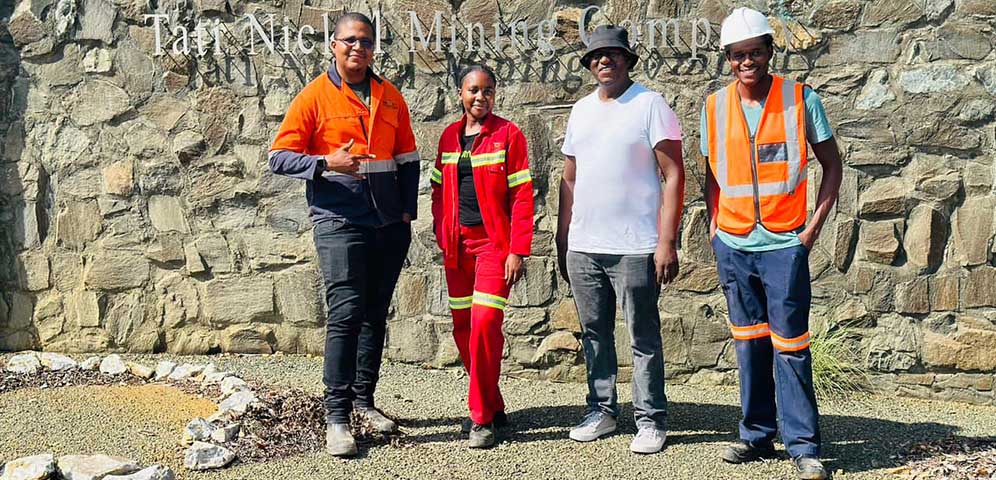
He said declining availability of high-grade nickel-cobalt sulphide ores has created economic challenges for mining operations in Botswana and Zimbabwe. He cited the financial difficulties experienced by TNMC and Bindura Nickel Corporation (BNC) in Zimbabwe, where processing lower-grade ores has proved costly.
The research followed four stages, beginning with the characterisation of nickel sulphide ores from TNMC and nickel oxide ores from BNC to establish their mineral composition and physical properties.
Researchers then investigated flotation techniques, including nanobubble and selective flotation, to separate valuable minerals from the ore.
The team also assessed the Activox process, in which concentrated ore is ground to a very fine powder and then treated under high pressure with chemicals that draw out the metals.
The team developed predictive models using statistical methods, artificial neural networks, and adaptive neuro-fuzzy inference systems to identify optimal grinding conditions.
Mamvura said the team faced significant challenges, including limited access to ore samples and equipment in Zimbabwe and corrosion of a reactor used during high-pressure leaching. Despite these, he said the team made several significant findings.
Flotation experiments achieved copper recovery of up to 65 per cent and nickel and cobalt recovery of about 29 per cent from raw ore samples.
Mamvura said characterisation of the Botswana nickel ore also identified opportunities to reduce milling requirements compared with the original Activox process, potentially lowering operational costs.
From laboratory research to industrial application
Mamvura said the findings show the potential to reprocess historical tailings and improve the economics of the Activox process.
He said the team’s work on optimising Activox addresses the cost issues that led to the technology’s abandonment at TNMC.
Although widespread industrial implementation has not yet taken place, Mamvura said the project has generated direct engagement with TNMC and other stakeholders.
He said it has been announced that the mine will reopen under new management, which presents an opportunity for future testing and uptake of the project’s recommendations.
The team hopes to engage with the company so its research can provide new data on the potential for reprocessing the mine’s ores and historical tailings, he said.
Further work is required to complete the high-pressure leaching stage, confirm metal recovery at pilot scale and demonstrate commercial viability, Mamvura said.
Partnership with industry and further investment will also be needed to scale up from laboratory experiments to pilot and commercial operations.
Building Africa’s battery value chain
Mamvura said Botswana and Zimbabwe both have substantial nickel and cobalt reserves, and that developing local beneficiation capacity would move both countries away from simply exporting raw materials.
“By developing a cost-effective method to process low-grade ores and tailings, we are creating a pathway to refine these minerals into battery-grade metals within Africa,” he said.
“This moves the value chain from extraction to processing and manufacturing, keeping more economic value on the continent.”
He added that the work could stimulate downstream industries, such as battery cell manufacturing, and that the long-term vision is to contribute to regional battery value chains rather than supply raw materials to overseas processors.
Research builds skills and collaboration
Mamvura said the project has also strengthened research capacity and collaboration between the two universities.
It supported two research assistants, one female and one male, who gained hands-on experience in mineral processing, hydrometallurgy and advanced modelling techniques.
One of them, Boitshepho Marakalala, said the project broadened her understanding of how mineral processing connects with battery technologies and the wider energy transition.
Her work involved sample collection and preparation, crushing, screening, milling and flotation, as well as downstream processes such as solvent extraction, precipitation and crystallisation to recover high-purity metal salts.
She said the experience encouraged her to look beyond conventional metal recovery and consider the quality and suitability of mineral products for energy applications.
“The most valuable gain from the project was a broader perspective on my technical background. It helped me develop as an independent researcher and showed me how mineral processing and materials research connect to larger global challenges like energy security, materials supply, and the energy transition,” Marakalala said.
Mamvura said the collaboration has also produced two open-access journal articles, and that the principal investigators from both universities have visited each other’s campuses to exchange knowledge.
Funding supports local innovation
Mamvura described SGCI funding as the cornerstone of the project. He said it paid for essential equipment, including a nanobubble flotation unit and an autoclave reactor, and for sample analysis at partner institutions in countries including South Africa and Japan. It also enabled the principal investigators from Botswana and Zimbabwe to meet in person.
The funding also allowed the team to reinvestigate and adapt a patent-protected technology, Activox, to local ore conditions, he said, opening the door to further innovation and potentially a new patent.
He said presenting the findings at the 2024 SGCI Annual Forum allowed networking with other researchers, and that the team is now engaging with other research groups on possible collaborative projects.
Mamvura said that if the work succeeds, it could support the revival and modernisation of nickel processing operations in the region.
Please check out the stories and let us know what you think. We would love to hear from you!
Let’s continue the conversation on our social media
Published on 5 November 2026
By Jackie Opara-Fatoye